Grok 4.7: cheap, long-context, and not the winner in its own comparison
Grok 4.7 lands at $2 and $6 per million tokens with a 500,000-token context window. Strong on coding benches, and still behind on some.
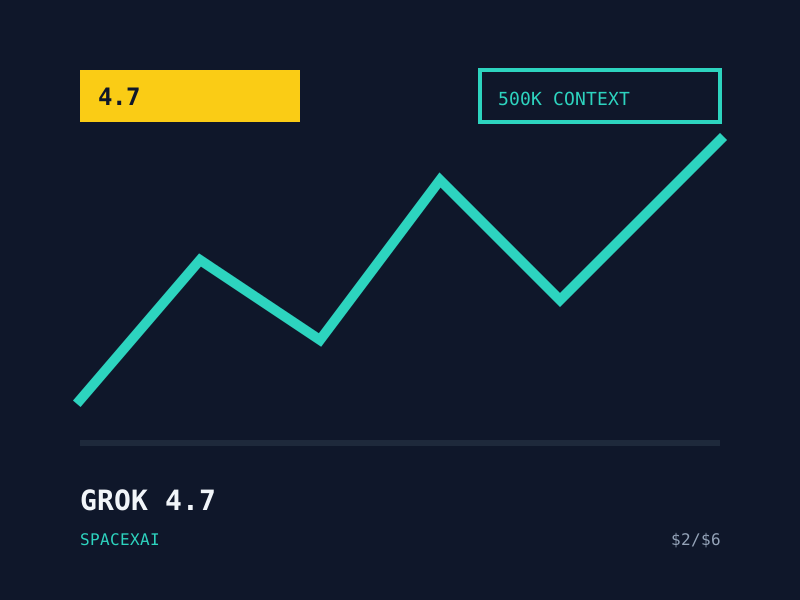
SpaceXAI released Grok 4.7 on 21 September 2026, describing it as its most capable model for coding and knowledge work. The headline numbers are the sort people like: a 500,000-token context window, a price that did not move, and a jump on the coding benchmarks SpaceXAI chose to publish.
There is a second set of numbers in the same announcement that gets less attention, and it is the more useful one. In SpaceXAI’s own comparison table, another model — Fable 5.1 Max — is ahead of Grok 4.7 on two of the four coding benchmarks. Grok 4.7 also trails on a medical benchmark. This is not a clean sweep, and the company did not pretend it was one.
Everything below is company-reported unless stated otherwise. That is normal for a launch post, and it is worth keeping in mind when you read any table in it.
What SpaceXAI shipped on 21 September
The model is built on a new, larger base model than Grok 4.6, and it was trained with a longer reinforcement learning run over a harder mix of tasks. SpaceXAI says the mix was weighted toward problems that take many hours to finish rather than quick one-shot questions.
That choice explains most of what the company emphasises. If a task takes hours, the model has to check its own work along the way and stay coherent while the context fills up. SpaceXAI’s claim is that Grok 4.7 is better at both: verifying its own work, and managing longer context. Neither of those is easy to measure from the outside, which is one reason the benchmark table carries most of the weight in the announcement.
The concrete specs are straightforward:
- 500,000-token context window
- Text and image input
- Model name
grok-4.7on the API
Two smaller claims are worth noting because they are specific. SpaceXAI trained the model to natively understand the Grok Bot harness, which launched on 11 August 2026. And the company says it is better at producing documents and presentations — useful if your work is writing rather than fixing code, and one of the few areas where a model can be checked by simply reading its output.
Pricing, and where you can actually get it
The standard price is $2 per million input tokens and $6 per million output tokens. That is identical to Grok 4.6, so this is not a release where the company is buying attention with a discount. The interesting number is the model capability per dollar, not the price.
There is a second tier. A “fast” variant runs at twice the output speed for twice the price, and 1.5x the price for long-context requests. That variant is not something you buy from the API — it is available only in Cursor and in Grok Build, and it is billed through your plan there. If you are working somewhere else, the fast tier is not an option, and the speed difference does not apply to you.
Availability is otherwise broad. Grok 4.7 is in Cursor, in Grok Build (which has a free tier for trying it), on the Grok API, in third-party coding harnesses, in model routers, and on cloud platforms. The previous generation widened its reach in August, when Grok 4.6 was extended to GitHub Copilot, Amazon Bedrock, the Gemini Enterprise Agent Platform and Microsoft Foundry.
If you want to try it before wiring anything up, Grok Build’s free tier is the cheapest way in. If you have an existing pipeline, the API model name is the part you need.
The benchmarks, read carefully
Here is the comparison table as SpaceXAI published it:
| Benchmark | Grok 4.7 | Comparison |
|---|---|---|
| CursorBench 4.0 | 46.3% | Grok 4.6: 40.4%; GPT-5.6 Sol: 41.7%; Fable 5.1: 51.8% |
| Terminal-Bench 4.0 | 38% | Grok 4.6: 20.3%; GPT-5.6 Sol: 37.3% |
| DeepSWE v1.1 (high effort) | 71% | Grok 4.6: 65.2%; GPT-5.6 Sol: 72.7%; Fable 5.1: 70% |
| EEBench (electrical engineering) | 64% | Grok 4.6: 53% |
On SpaceXAI’s own numbers, the gains over Grok 4.6 are consistent. CursorBench goes from 40.4% to 46.3%, Terminal-Bench nearly doubles from 20.3% to 38%, and EEBench climbs from 53% to 64%. Every coding benchmark the company published moves the same direction. These are vendor-published deltas rather than independently verified ones, so treat the size of the improvement as a reason to measure on your own code, not as a settled result.
Now the parts that cut the other way.
Fable 5.1 is ahead on CursorBench at 51.8%, more than five points clear of Grok 4.7’s 46.3%. In the prose version of the comparison — the one that uses the full “Max” product names — Fable 5.1 Max is also ahead on Terminal-Bench. So the model SpaceXAI is presenting as its best coding model is behind a competitor on two of the four coding benches it chose to include.
DeepSWE v1.1 is closer. Grok 4.7 scores 71%, GPT-5.6 Sol scores 72.7%, and Fable 5.1 scores 70%. That is a 2.7-point spread between the best and worst of the three, which is the kind of gap that should not decide anything on its own.
Outside the coding table, Grok 4.7 scored 56.7% on HealthBench Professional, trailing both GPT-5.6 Sol Max and Fable 5.1 Max. If you are picking a model for anything clinical, regulatory, or otherwise high-stakes, that line is the relevant one, and it is not a lead.
There is also a fair criticism of the setup. One user on X asked why SpaceXAI compared Grok 4.7 at xhigh effort against Grok 4.6 at high. Effort settings change how much reasoning a model spends, and comparing the strongest configuration of the new model against a lighter configuration of the old one inflates the difference. It is a small thing to get worked up about, but it is the kind of detail that tells you how much weight a launch table deserves.
The safety case is part of the pitch
SpaceXAI says Grok 4.7 was built with an entirely new safeguard stack, and that it is the company’s strongest model yet on refusals and jailbreak resistance. On HackerBench v0.3, the company’s benchmark for risky cyber tasks, the model lets through only 3.3% of risky dual-use prompts, while the company says it rarely blocks legitimate security work.
It scored 62.4% on LatchBio’s biosafety benchmark. Select cybersecurity partners get invite-only access to its red-team capabilities.
None of this is independently verified in the announcement, and the honest read is that the refusal and jailbreak numbers describe the model’s behavior under SpaceXAI’s own harness with SpaceXAI’s own tests. The “rarely blocks legitimate security work” claim is the part to watch in practice, because over-blocking is the failure mode that hurts real users, and benchmark suites are poor at measuring it.
Three things to watch
- Token consumption. TechRepublic warns that heavy token consumption could raise the real cost of completing tasks, offsetting the low per-token price. The mechanism is plain arithmetic: at $2 and $6 per million tokens, a task costs exactly what you feed it and what it writes back, and this is a model trained for work that runs for many hours inside a 500,000-token window. A long session resends its growing context on every turn, and a retry pays for the whole thing again. The fast tier makes the same point from the other side — twice the price buys twice the output speed, which is a wash only if you buy exactly as much output as you otherwise would. A model that is good at spending two hours on a problem is not automatically cheap.
- Harness dependence. One report notes that independent results depend noticeably on the runtime environment and the workload type. The same model in a different harness can land somewhere else entirely, which is also a good reason not to over-read a vendor table.
- Encrypted reasoning. On the Responses API, reasoning items come back encrypted and must be passed back unchanged in multi-turn conversations. Get that wrong and you will lose the chain of reasoning mid-task, with no obvious error to point at.
What this means for you
Run it on your own workload. The benchmarks tell you roughly what to expect; only a trial on the code you actually maintain, or the documents you actually write, will tell you anything useful. If you already use Grok 4.6, the price is unchanged, so the cost of finding out is low — but measure what the upgrade does on your own tasks before you move.
If you are choosing between models from scratch, the comparison is closer than the launch post suggests. Three models sit within 2.7 points of each other on DeepSWE, and a fourth is ahead on two coding benchmarks and behind on one medical one. The deciding factor is more likely to be which harness you already run, how fast it feels on your files, and what it costs you per task.
On that last point, measure cost per finished task, not per-token price. The $2 and $6 figures are easy to compare on paper. The number that matters is what you spent on the hour when the thing finally worked, including the retries. Take a representative task from your week, run it on two of these models, and compare the totals. That single afternoon will tell you more than every benchmark in the launch post.
Sources
- SpaceXAI, “Introducing Grok 4.7” (https://x.ai/news/grok-4-7)
- SpaceXAI Docs, “Grok 4.7” (https://docs.x.ai)
- Unite.AI, “SpaceXAI Releases Grok 4.7 for Coding and Knowledge Work”
- TechRepublic, “SpaceXAI Launches Grok 4.7: Low Prices, Heavy Token Use”
- TestingCatalog, “SpaceXAI releases Grok 4.7 for coding and knowledge work”
- Incrypted, “SpaceXAI Unveiled Grok 4.7 With a Focus on Coding and Multi-hour Tasks”
- RSWebsols, “SpaceXAI introduces Grok 4.7”